



Commercial Furniture for Retail and Business Environments: A Complete Buying Guide
A checkout counter is used by every customer who pays. A clothing rack gets loaded, pushed, and rearranged for years. A jewelry cabinet must display small, expensive items while keeping them safe. Furniture that does these jobs badly costs you twice, once when you buy it and again when you replace it.
This guide is for store owners, fit-out contractors, and importers buying commercial furniture for retail, office, and hospitality spaces. It covers materials, the rules a US buyer should check, custom versus standard production, how to vet a manufacturer, and what to send when you ask for a quote. Where a number or requirement comes from a standard, the standard is named so you can look it up.
Key points
- Match the material and grade to the environment, and get both in writing on the quote.
- For US projects, check counter height rules, formaldehyde limits for MDF, and safety glass for anything customers can reach.
- Custom furniture usually costs more per unit and takes longer, but it solves odd layouts and keeps multiple stores consistent.
- Ask for a sample before a large order.
- Confirm the packing method early, because export packing has its own rules.
What Counts as Commercial Furniture
Commercial furniture is built for businesses, where many people use it every day and where the piece has a job beyond looking good: holding stock, taking payment, protecting valuables, seating guests, or supporting daily work. Residential furniture is designed for lighter use, which is why a home sideboard rarely lasts as long as a shop display.
It also comes with obligations that home furniture mostly avoids. In the US, sales counters fall under accessibility rules, and composite wood panels are subject to formaldehyde limits. Both are covered below.
Who Buys It and What They Need
Retail Stores
Every store needs a point of sale. A retail checkout counter must hold a register or terminal, route cables, provide storage for supplies, and stay presentable after years of daily use. A typical made-to-order build combines a stainless steel frame, a glass top, and MDF panels, with integrated lockable cabinets, and the size, layout, and materials can be adjusted to the shop. tradewheel
Boutiques and Fashion Stores
Clothing needs display racks with the right hanging rail height, enough shelf depth for folded stock, and a frame that won't flex under a full load. Footwear and bags need different support. For example, an aluminum-frame shoe and bag rack with acrylic panels and storage drawers can work well; see our shoe and bag display rack for layout ideas. tradewheel
Jewelry Stores
Jewelry display cabinets have two competing jobs: visibility and security. Prioritize lock quality and glass type first, then lighting and viewing height. Stainless steel frames with MDF panels are a common construction, and size, structure, and finish can be tailored to the store. tradewheel
Offices and Business Spaces
Offices need desks, storage cabinets and meeting or lunch tables that handle daily use without sagging or chipping. Made-to-order stainless steel office desks are one example from our range. tradewheel
Hospitality
Hotels, restaurants, and cafes buy furniture for serving, dining, and guest areas, where cleaning is frequent, and surfaces see constant contact. Multi-layer stainless steel hotel serving trolleys are an example of a piece built to order for this sector. tradewheel
How to Choose Commercial Furniture
Start With Use and Load
Write down how the piece will be used before you look at finishes. How many people touch it each day? What will sit on it, and how heavy is that stock? Ask the supplier for a load rating per shelf, rail, or counter section, and ask what it is based on. If they cannot give you a number, test a sample with your real products.
Match Material to Environment
A dry indoor boutique and a coastal cafe need different materials. The next section covers each material in detail. The short version: choose by moisture, cleaning chemicals, impact, and budget, in that order.
Measure the Space and the Route
Measure the room, then measure the path the furniture must travel to get there: doors, elevators, stairwells, and loading areas. A cabinet that fits the corner but not the entrance is a common and expensive mistake. Check the depth and swing of doors and drawers so they don't block walkways, and make sure the piece lines up with existing equipment such as a register, a security gate, or a lighting rail.
Decide How the Piece Must Function
Consider storage, mobility, adjustable shelves, cable access, and lighting. If a cabinet needs internal lighting, the supplier has to plan for the power run and heat at the design stage, not as an afterthought.
Plan the Finish and Brand Look
Some stores want furniture that carries the brand, in specific colors, edge profiles, logos, or materials. Others want a neutral look that stays out of the way. If you run several locations, decide early whether every store must match, because that drives the custom-versus-standard choice.
Think About Cleaning and Repair
Ask who will clean and repair it, and with what. Acrylic scratches more easily than glass, so avoid harsh scrubbing. Polished metal shows fingerprints more than a brushed finish. Hardware such as hinges, locks, and drawer slides should be replaceable, so ask whether the order includes spare parts.
Materials Compared
| Material | Strengths | Limits | Often Used For |
|---|---|---|---|
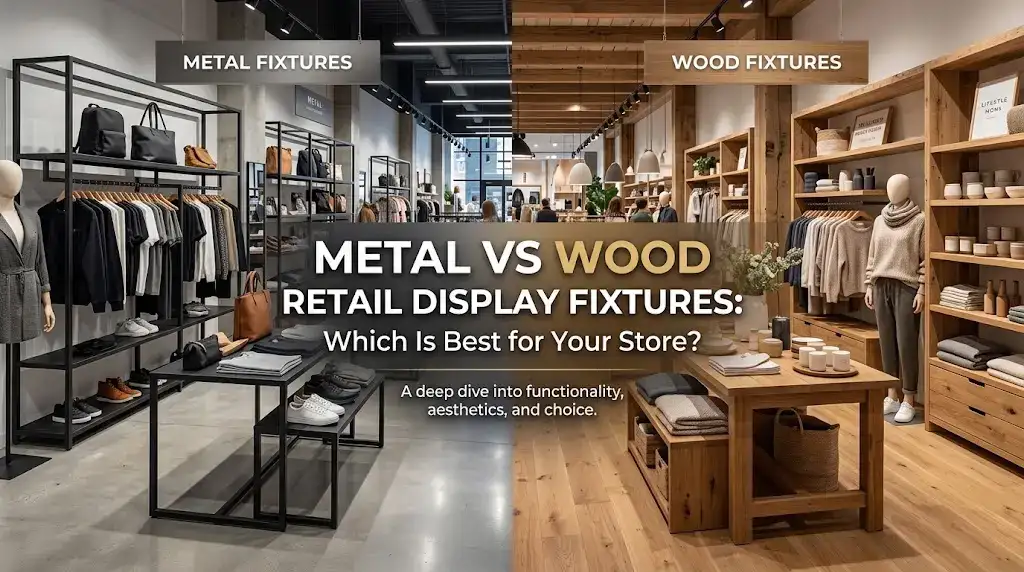
| Stainless steel 304 | Strong, corrosion resistant, easy to clean | Costs more than aluminum or MDF, heavy | Frames, counters, trolleys, desks |
| Stainless steel 201 | Lower price | Less corrosion resistance, suited to dry indoor use | Decorative or low-moisture pieces |
| Stainless steel 316 | Best resistance to salt and harsh chemicals | Highest cost of the three | Coastal sites, wet or chemical areas |
| Aluminum | Light, corrosion resistant | Softer than steel, can dent or bend under heavy point loads | Racks, frames, mobile pieces |
| MDF and wood | Wide choice of finishes, good for custom shapes | Swells if water reaches the core, formaldehyde rules apply | Panels, shelves, cabinet bodies |
| Tempered glass | Clear, strong, safer when broken | Heavy, edges and corners need care | Tops, shelves, doors |
| Acrylic | Light, does not shatter like glass | Scratches easily | Side panels, light shelving |
Stainless Steel: Ask for the Grade
Stainless steel is sold by grade, and the grade matters more than the word "stainless." Grade 304 holds about 18% chromium and 8% nickel and is the most widely used grade. Grade 316 adds 2 to 3% molybdenum, which improves resistance to chlorides such as salt air. Grade 201 suits dry, indoor, decorative use where corrosion resistance is not critical. 201 costs less because it uses less nickel and more manganese and nitrogen. alibabamaidsafe
For an indoor shop, 304 is treated as the standard grade for indoor commercial furniture. For coastal sites, near pools, or in kitchens with strong cleaners, price 316 as well. Whatever you pick, put the grade on the quotation and ask for a material certificate. Rust spots on stainless furniture are often traced to lower-grade steel or poor passivation, so specify a minimum grade and request a certificate. alibabaalibaba
Aluminum
Aluminum is light and resists corrosion, so it suits racks, frames, and anything that gets moved often. It is softer than steel, so heavy shelves need thicker profiles or extra supports. Ask how the supplier handles load on long spans.
MDF and Wood: Check the Board Certification
MDF takes paint, laminate, and veneer well and costs less than solid wood, but it swells when moisture gets into cut edges. It is also a regulated material in the US. EPA's limit for MDF is 0.11 ppm formaldehyde, in force since June 1, 2018, and composite wood must be certified by a recognized third-party certifier. These limits match California's CARB Phase 2 standard, so products that meet Phase 2 also meet the federal rule. EPA names importers, furniture wholesalers, and furniture stores among the businesses covered. Small entity compliance for formaldehyde standards importers, distributors, retailers 4.20.2018 +2
If you import to the US, ask which certified board supplier the factory uses and request the certification details before you order.
Glass and Acrylic: Specify the Glass
In North America, safety glass is checked against ANSI Z97.1 and CPSC 16 CFR 1201, and in the EU tempered glass is covered by EN 12150. Tempered glass is up to four times stronger than annealed glass and breaks into small, blunt pieces instead of long, sharp shards. That's why you should specify tempered glass for tops, shelves, and doors that customers can reach. alibabageneralglass
ASTM F2813 goes further for desks and tables and requires tempered or laminated safety glass for unenclosed horizontal glass surfaces under 44 inches. Whether it applies to your counter depends on the product and local rules, so ask the supplier what glass it uses and which standard it is tested to. astm
Acrylic is lighter and does not shatter like glass, but it scratches more easily. It works well for side panels and light shelving, less well for surfaces that get wiped constantly.
Planning Furniture for a Retail Store
Start With the Floor Plan
Measure the store, mark entrances, the checkout, the stockroom door, and any fixed equipment, then place furniture on the plan before you order anything. Leave room for future changes, such as adding a second register.
Match Furniture to Zones
Put the checkout counter where staff can see the entrance and the main sales floor. Keep clothing racks and shoe displays together so customers can compare. For jewelry, choose cabinet height around your customers' average viewing level, and keep the lock side facing staff. Store anything valuable or fragile out of customer reach.
Check Counter Height Rules (US)
In the US, the 2010 ADA Standards for Accessible Design cover sales and service counters. For a parallel approach, which is how most counters are used, at least 36 inches of the counter must be no higher than 36 inches above the floor. Counters at checkout aisles can go up to 38 inches. A sales counter with no section at or below 36 inches does not meet the rule, so ask for a lowered or split-height section in the design. natsoaccess-board
Rules differ for existing buildings, other countries, and local codes. Read the standard and check local code for your site. This is general information, not legal advice.
Keep Sightlines and Walkways Clear
Furniture should show products without blocking views. Tall cabinets in the middle of the floor can hide customers from staff, so keep them along walls or in zones with extra staff coverage. Make sure walkways stay clear when doors and drawers are open.
Keep the Look Consistent
If you operate several stores, use the same finish, edge profile, and hardware across locations. This is where custom production helps most, because standard catalog pieces change over time and may not match later.
Custom vs Standard Commercial Furniture
| Factor | Custom | Standard |
|---|---|---|
| Dimensions | Built to your measurements | Fixed sizes from the supplier |
| Design and branding | Flexible, can follow brand specs | Limited to what is offered |
| Space use | Can fit odd layouts and corners | Depends on available sizes |
| Lead time | Usually longer, includes sample approval | Usually shorter |
| Unit cost | Usually higher, often drops with larger quantities | Usually lower |
| Multi-store consistency | Same spec repeated per order | Depends on the item staying in range |
When custom makes sense: unusual floor plans, several stores that need to match, brand-specific finishes, or a need to fit furniture around existing equipment.
When standard is enough: simple layouts, short timelines, small budgets, or when a catalog size already fits.
Our commercial pieces are built to order, so a custom spec is the normal route with us. If you are unsure whether a standard option would work for your project, send us your measurements, and we will tell you.
How to Choose a Commercial Furniture Manufacturer
Treat this like any supplier check. You are buying production, not just a product photo.
Ask for the business license and any certifications relevant to your market. Ask what the factory makes in-house: metal fabrication, woodworking, glass handling, finishing.
Ask for the stainless grade, the board type and its formaldehyde certification, and the glass type and thickness, all in writing.
A serious manufacturer will work from CAD files, sketches, reference photos, or an existing sample, and will produce a prototype or sample before mass production.
Ask what is checked and when: incoming material, in-process checks, dimensions, finish, final inspection, and packing. Ask for inspection reports or photos for your order, and consider an independent inspection company for large orders.
MOQ depends on the product, material, and finish. Ask for MOQ, sample lead time, production lead time, and repeat-order lead time. For our products, contact us for MOQ.
Ask how the factory packs and documents export shipments; covered below.
How to Order Custom Commercial Furniture
- Define the product, quantity, dimensions, materials, finish, color, and function.
- Prepare drawings or references: CAD files, sketches, photos, or a sample.
- Request a quotation that lists specifications, packaging, destination, and timeline.
- Review the sample or prototype and request changes.
- Confirm the final specification in writing.
- Arrange inspection and approve packing before shipment.
What to include in an RFQ: floor plans or layout drawings, dimensions, material and grade, finish standards, load requirements, quantity and bill of quantities, glass or hardware specs, installation needs, destination port or address, packing requirements, target delivery date and warranty terms.
Packing and Export Rules
Furniture can be damaged in shipping, and wood packaging has its own legal requirements.
ISPM 15 applies to solid wood packaging such as pallets and crates used in international trade, while manufactured wood such as plywood, OSB and particleboard is exempt. Heat treatment means holding a core temperature of at least 56 °C for 30 minutes, and the packaging must then carry the official mark. Wood 6 mm or thinner is also exempt. Non-compliant wood packaging can lead to a treatment order, re-export, or destruction. Some countries add requirements beyond ISPM 15, so check your destination. ISPM 15 export pallets +3
Ask how your order will be packed, whether crates are treated and marked, and how glass and finished surfaces are protected. Ask for photos of packing before the shipment leaves.
Common Mistakes and a Pre-Order Checklist
Mistakes to avoid
- Choosing on appearance alone and ignoring load and use.
- Skipping the sample on a large order.
- Comparing only unit price and ignoring freight, packing, installation, and replacement parts.
- Accepting "stainless steel" with no grade on the quote.
- Not checking counter height, glass type, or board certification for the US market.
- Forgetting to measure doors and routes into the building.
Before you order, confirm:
- dimensions, quantity, load requirements, storage needs, hardware, finish, and color.
- stainless grade, board certification, glass type and standard, counter height rules for your site.
- sample approval, MOQ, production lead time, warranty and after-sales terms.
packing method, ISPM 15 status of crates, destination, inspection before shipment.
Frequently Asked Questions
What is the difference between commercial and residential furniture?
Commercial furniture is built for heavy daily use by many people and often has to meet safety or accessibility rules. Residential furniture is designed for lighter use.
Is custom commercial furniture more expensive than standard?
Per unit, usually yes, because of design time and sample approval. Larger quantities tend to reduce the difference. Ask for quotes on both if a standard size could work.
Which stainless steel grade should I ask for?
For dry indoor use, 304 is the common reference. For coastal or chemical-heavy environments, consider 316. Whichever you choose, get the grade written on the quote.
Does the glass on a checkout counter need to be tempered?
Tempered or laminated safety glass is the usual choice for surfaces customers can reach, and the US reference standards are ANSI Z97.1 and CPSC 16 CFR 1201. Confirm the glass type and the standard it meets with your supplier and local code.
What is your MOQ?
It depends on the product, material, and finish. Contact us with the item and quantity, and we will confirm the MOQ.
What should I include in an RFQ?
Drawings or layouts, dimensions, material and grade, finish, load needs, quantity, destination, packing requirements, and timeline.
Conclusion
Buy commercial furniture by use, material, size, and compliance, in that order. Get materials and grades in writing, approve a sample, and confirm packing before placing the order. For US projects, check counter height, board certification, and safety glass early.
If you need counters, racks, or cabinets built to your layout, see our commercial furniture range and contact us with your drawings or reference photos. Foshan Kangbao Home Technology Co., Ltd. builds commercial pieces to order, and we can confirm MOQ, sample, and lead time for your item.
Leave Your Comments


Foshan Kangbao Home Technology Co., Ltd

Have a question or need a quote? Fill out this form and our team will get back to you quickly!